
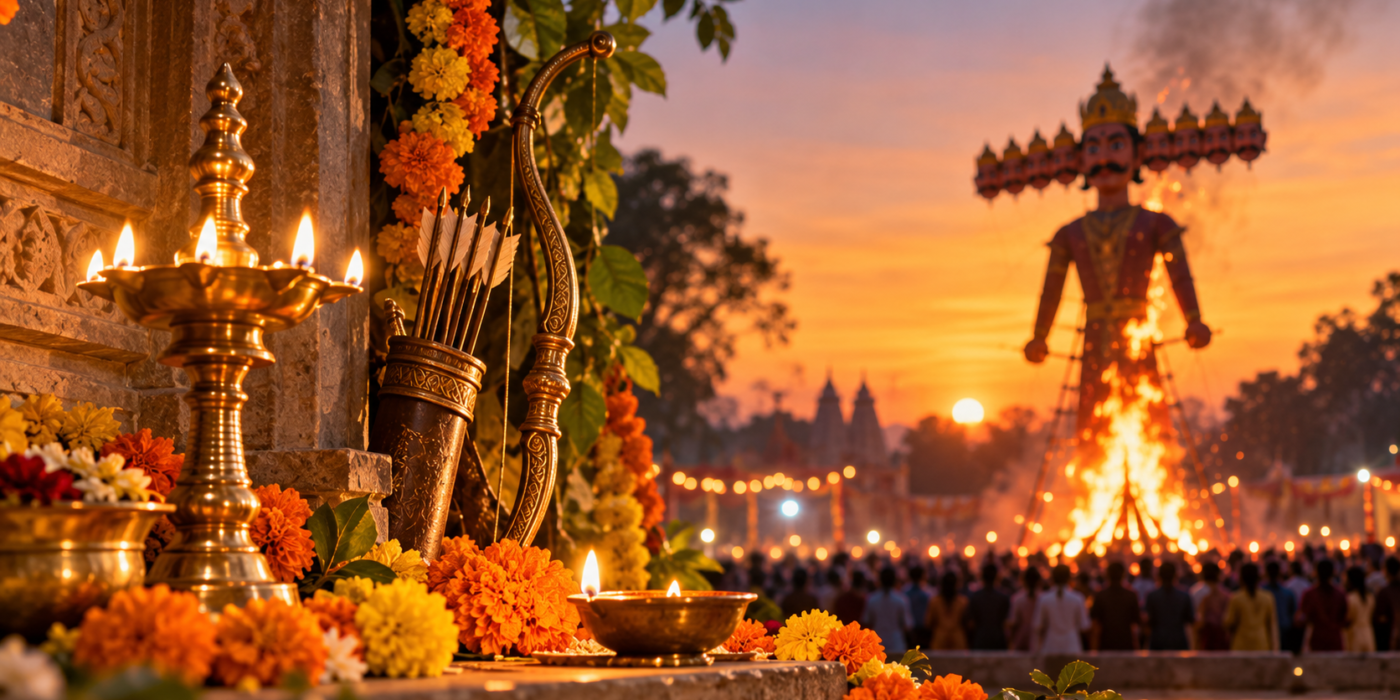
Vijayadashami, also called Dussehra or Dasara, marks the victory of good over evil on the tenth day after the nine nights of Navratri. In traditions rooted in the Ramayana, it commemorates Lord Rama’s victory over Ravana. In others, it celebrates Goddess Durga’s triumph over Mahishasura. Its meaning is often summed up in one phrase, but the festival raises a harder question that is easy to skip: once the battle is over, what do we do with the victory?
That question, rather than the battle itself, is the focus of this reflection. In 2026 Vijayadashami falls on 20 October, according to the Delhi panchang. Local calendars can differ.
What does Vijayadashami celebrate?
The name is usually translated as “the victorious tenth” (RE:ONLINE): vijaya means victory, and dashami refers to the tenth day. Gurudev Sri Sri Ravi Shankar describes the sequence simply: Navratri honours the Divine Mother for nine days, and the tenth day marks victory (Gurudev’s Vijayadashami message).
How that victory is celebrated depends on where you are. The Art of Living’s guide to Navratri across India describes several traditions:
- Northern India: the festival ends with re-enactments of the Ramayana and the burning of Ravana’s effigy.
- West Bengal: the final days are celebrated as Durga Puja, and the images of the goddess are immersed on Vijayadashami.
- Mysuru: Dasara is celebrated with great ceremony.
- Kerala: the tenth day is Vidyarambham, when young children are formally introduced to learning.
In Karnataka, the Art of Living notes, the season’s celebrations recall Goddess Chamundeshwari’s slaying of Mahishasura (Ayudha Puja).
Each of these stories has its own history and meaning. What follows draws on one strand of interpretation among several. Our Navratri reflection explores the Durga–Mahishasura story, so this piece stays mostly with Rama and Ravana.
Ravana as the ego: the inner reading
The Art of Living’s explanation of Dussehra reads the Ramayana allegorically. Ravana “represents the ego”. His ten heads “represent ten negative qualities to be eliminated”, and burning his effigy “signifies the need to eradicate these negativities within ourselves”.
Gurudev’s 2016 Vijayadashami message makes the same point more directly: “Ravana is symbolic of the ego.” Against this, he says, only self-knowledge works. He places that knowledge somewhere unexpected for a festival of battle: “Lord Rama can be experienced only in deep rest when one reposes in the Self.” On this reading, the victory comes less from force of will than from the kind of quiet in which a person can see themselves clearly.
This is a spiritual interpretation, offered within a particular teaching tradition. It is not the only way to read the Ramayana, and it does not replace the devotional meaning the story holds for many families. Its usefulness is that it turns a public spectacle into a private question. Most of us can name what is wrong with someone else. It is harder to notice how impatience, pride, resentment or the need to have the last word quietly steer our own decisions.
Seeing that clearly is not the same as condemning yourself. Responsibility starts with recognising a pattern and its effects, and then choosing a better response next time.
Why the inner reading guards against self-righteousness
Stories of good defeating evil can give people courage. They can also be misused, as licence to divide the world into the wholly good and the wholly bad, with ourselves always on the right side.
The ego reading works against that. If Ravana stands for tendencies every person carries, then the burning effigy points back at the person watching it. A person can act wisely in one situation and badly in the next. We can hold someone accountable for harm, and still need boundaries and justice, without pretending we are beyond making the same mistakes.
The change is in the question. Instead of asking only “Who is wrong here?”, the festival invites a second one: “What is the right action for me now?”
What does renewal look like after the victory?
Renewal is often imagined as a dramatic fresh start. In practice it tends to be smaller and harder: listening fully before replying, admitting that an earlier decision was mistaken, dropping a grievance that has taken up too much space, or returning to a commitment you let slide.
None of these makes life easier overnight. What they do is create room for a different response the next time the old pattern appears.
Gurudev’s message also describes a symbolic offering into the fire of knowledge (aahuti), which he explains as letting go of the cravings and aversions gathered over the year. You do not need to attend a ceremony to take the idea seriously. What, in the past year, are you still carrying that you could finally put down?
The same message suggests asking two older questions: “Who am I?” and “What is my true purpose in life?” It also encourages taking part in service. Neither is meant to be solved in an evening. They are useful precisely because they move attention from winning to living well afterwards.
Three questions to take into the day
A few quiet minutes are enough:
- What am I ready to stop carrying? Name one habit, reaction or resentment that no longer serves you.
- What needs to be put right? Perhaps an apology, an honest conversation or a change in how you behave towards someone.
- What quality do I want to practise? Choose one, such as patience, courage, generosity or restraint, and one situation this week in which to practise it.
Keep the answers small enough to act on. One sincere change you actually make is worth more than a long list of resolutions forgotten by Diwali.
Beyond the tenth day
The effigies will burn, the immersions will end and ordinary routines will return. In my view, the inner renewal Vijayadashami points towards is less a declaration that we have overcome our weaknesses than a willingness to keep seeing them clearly, without harshness towards ourselves and without losing compassion for others.
So the question worth carrying out of the festival is not only what we celebrate defeating, but what we choose to do differently now that the day is over.

Leave a Reply