
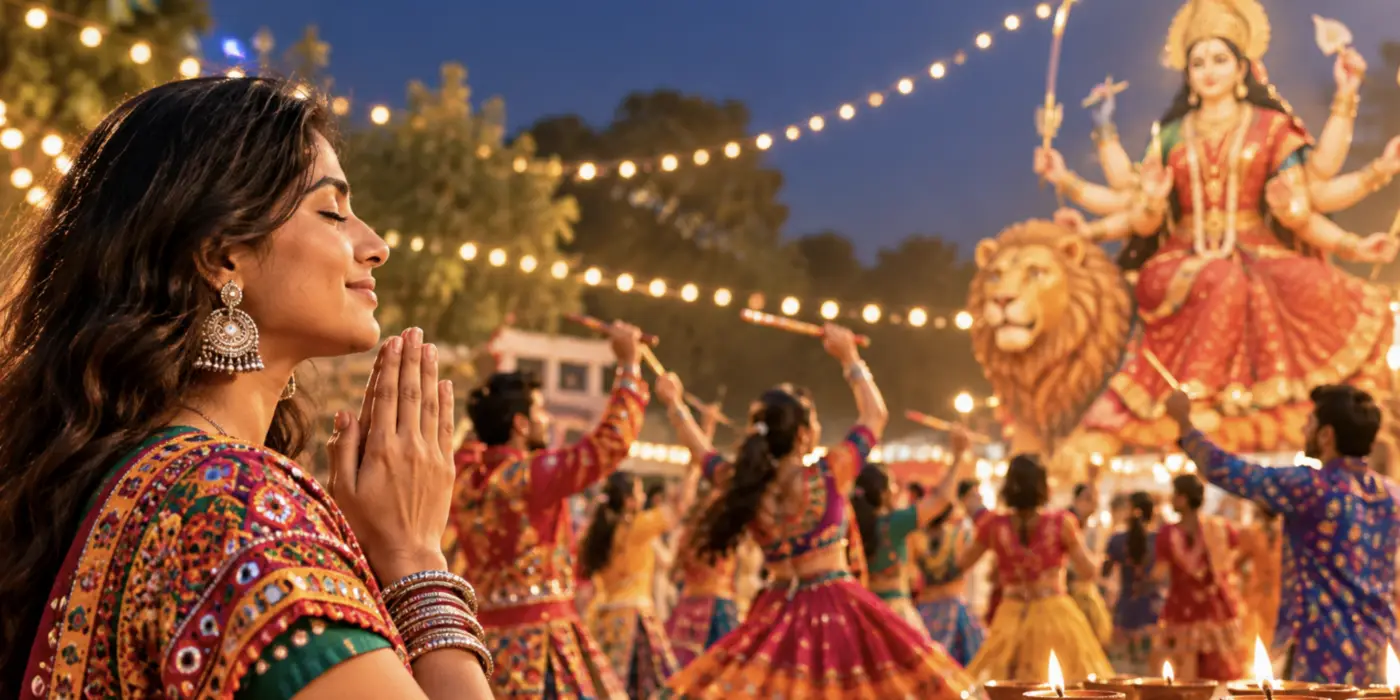
Navratri arrives with the rhythm of Garba, devotional songs, lamps and gatherings of family and friends. Beneath the colour lies a quieter invitation: to use these nine nights to look honestly at the habits that hold us back, and to make room for a little more courage, devotion and renewal.
What Does Navratri Mean?
Navratri means “nine nights” in Sanskrit: nava is nine and ratri is night (The Art of Living). The festival honours the Divine Feminine, or Shakti, worshipped in many traditions as Goddess Durga and her forms. Two Navratris are widely observed: Chaitra Navratri in spring and Sharad Navratri in autumn. Sharad Navratri falls in the lunar month of Ashvin. In 2026, it began on 11 October, and Vijayadashami falls on 20 October, according to the Delhi Panchang. Local calendars can differ.
Gurudev Sri Sri Ravi Shankar offers two interpretations that shape the lessons below. Nav, he notes, also means new, making these “nine new nights” (Gurudev’s explanation). He also explains ratri in terms of deep rest, describing the festival as “a time of prayer and rejuvenation”: “These nine days are like coming out of a mother’s womb once again.”
1. Courage Is Not the Absence of Fear
One of the best-known stories associated with Navratri is Goddess Durga’s victory over the buffalo demon Mahishasura. In the Art of Living’s retelling, the gods combine their powers to bring forth Durga, and the day of her victory is celebrated as Vijayadashami. For devotees, this is the triumph of divine strength over destructive forces, and that devotional meaning stands on its own.
The same source also reads the story symbolically: Mahishasura “symbolizes lethargy, inertia, pride, obsession, cravings, and aversions”. That list is worth noticing. It does not name an external enemy. It names inertia alongside pride, which suggests that courage is needed as much for what we keep postponing as for what we openly fight.
In everyday life, courage is rarely dramatic. It can mean acknowledging a mistake instead of defending it, having a difficult but necessary conversation, standing up for someone who is being treated unfairly, or beginning again after a disappointment.
A useful question to carry through the festival is: What am I avoiding because facing it would require courage? The answer does not need a grand gesture. One honest step is enough.
2. Devotion Is More Than Ritual
For many people, Navratri means puja, fasting, chanting, temple visits and community celebrations. These practices connect people with their faith, their family traditions and each other.
Devotion also raises a harder question: what happens to the values we celebrate when ordinary life resumes? It is possible to take part in a beautiful celebration and still carry impatience into our conversations or harshness into our relationships. That is no argument against ritual. It is a reminder that the attitude behind it matters.
The Art of Living’s explanation of Navratri describes it as a time when “you turn inward towards your source” and invites us to “invoke the positive qualities that are within us”. It does not prescribe one routine for everyone. For one person, devotion means regular prayer. For another, it is chanting, meditation or silence. Someone else may express it by caring for an elderly parent, helping a neighbour or offering seva, service done without seeking recognition.
A simple test makes this personal: Does my devotion influence how I treat people when no one is watching?
3. Inner Renewal Begins With a Pause
Gurudev describes Navratri as “a time for self-referral and bringing the mind back to the source”. In the same talk, he links the nine days to the three gunas, the basic qualities described in Indian philosophy. The first three days correspond to tamas (inertia), the next three to rajas (restlessness and activity), and the last three to sattva (purity and clarity). The Art of Living also discusses these qualities in its explanation of Navratri’s significance. In this interpretation, what emerges on the tenth day is “pure love and devotion”. Renewal is a gradual settling rather than a sudden change.
Rest of this kind does not mean avoiding responsibility. It means creating enough quiet to meet responsibilities with a clearer mind.
You do not need hours to begin. For five minutes each day of the festival, sit comfortably, put your phone away and be quiet. You might pray, repeat a familiar mantra, meditate or simply notice your breathing without forcing any particular experience. Thoughts will come. Treat them as part of the practice, not a failure, and gently return to what you chose.
Afterwards, three questions can help:
- What has been occupying most of my attention lately?
- Which habit or reaction would I like to approach differently?
- What quality do I want to nurture in the coming days?
Renewal often begins with something small: noticing a familiar reaction and choosing not to respond in the usual way.
Many Ways of Celebrating Navratri
Navratri is not celebrated identically across India, and each tradition has its own history and meaning. In Gujarat, Garba and Dandiya-Raas bring communities together in circular dance. In West Bengal, the final days are celebrated as Durga Puja, with images of the goddess in pandals. In Tamil Nadu and Karnataka, families arrange Kolu (Bommai Kolu or Bombe Habba), tiered displays of dolls. In Kerala, the tenth day marks Vidyarambham, when young children are initiated into learning. Much of northern India stages re-enactments of the Ramayana that culminate in Dussehra. The Art of Living’s guide to Navratri across India describes these traditions in more detail.
An inward approach does not need to replace any of this. A night of Garba is a celebration in its own right, and not every moment has to become a lesson. The invitation is to notice what the festival awakens in you, and whether some of it can last beyond the tenth day.
A Small Intention to Carry Forward
A small intention usually outlasts a grand festival resolution. Choose one quality you want to strengthen, such as courage, patience, gratitude or kindness, and tie it to an action you can actually take. If you choose courage, raise the subject you have been avoiding. If you choose patience, pause before replying in anger. If you choose gratitude, tell someone what their presence means to you.
Beyond the Nine Nights
The music will quieten and ordinary routines will return. One question is worth keeping: What is one quality I can nurture in myself, and one action through which I can express it? Honouring Navratri beyond the nine nights does not mean becoming a different person overnight. It can mean taking a small, conscious step towards the person you hope to be.
Editorial note: This article offers a contemporary reflection on Navratri, drawing on published teachings of Gurudev Sri Sri Ravi Shankar and the Art of Living. Spiritual interpretations and regional practices are presented as such, not as scientific findings or as the only way to understand the festival.
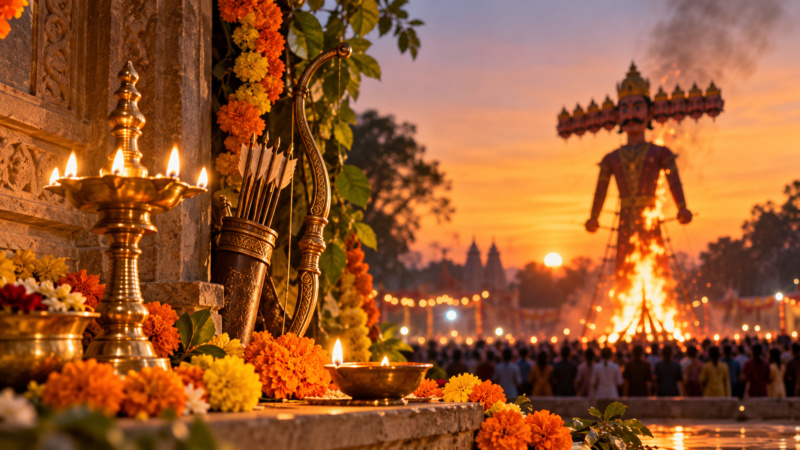

[…] own history and meaning. What follows draws on one strand of interpretation among several. Our Navratri reflection explores the Durga–Mahishasura story, so this piece stays mostly with Rama and […]