
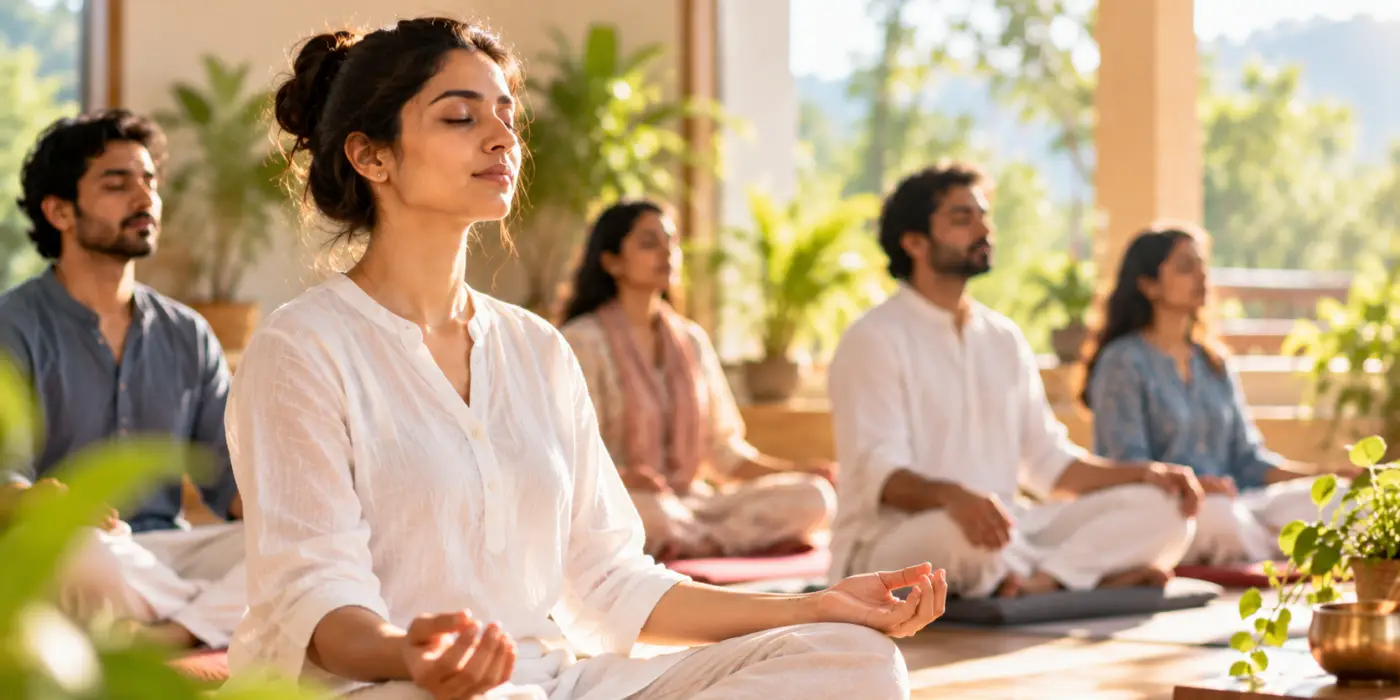
Sudarshan Kriya is a rhythmic breathing technique taught by the Art of Living. The organisation says Gurudev Sri Sri Ravi Shankar cognised it in 1981. It is learned in a short, instructor-led course rather than from a book or video, and is then practised at home in a shorter daily form. The Art of Living describes it as harmonising “the body, mind and emotions”. Published research, mostly on courses that combine the breathing with meditation and follow-up, has reported encouraging results for stress and mood. That research also has clear limits, and none of it makes Sudarshan Kriya a medical treatment.
That one paragraph contains four different kinds of information: what the organisation says about the practice, how it is taught, what researchers have measured, and what remains uncertain. Much of the confusion around Sudarshan Kriya comes from blurring these together. In my view, someone deciding whether to spend four evenings learning a breathing practice deserves to know which kind they are reading at any given moment, so this guide keeps them apart.
Sudarshan Kriya at a glance
| Question | Short answer | Source |
|---|---|---|
| What is it? | A rhythmic breathing technique | Art of Living Q&A |
| Who teaches it? | The Art of Living, founded by Gurudev Sri Sri Ravi Shankar | Art of Living |
| How is it learned? | In the in-person Happiness Program or the live Online Meditation and Breath Workshop | Art of Living |
| Is it meditation? | No. It is a breathing technique that helps a person reach a meditative state | Art of Living Q&A |
| Is it religious? | It is not, and people of many faiths practice it | Art of Living Q&A |
| Can I learn it online for free from a video? | No. It is “not to be downloaded” and teaches it through its courses | Art of Living Q&A |
Where Sudarshan Kriya comes from
According to the Art of Living, Gurudev Sri Sri Ravi Shankar cognised Sudarshan Kriya on 17 September 1981, on the banks of the Bhadra river in Shimoga, Karnataka, after ten days of silence and fasting (What is Sudarshan Kriya). “Cognised” is the organisation’s word. It presents the technique as something that arose in meditation rather than something designed in a laboratory. As the same page quotes him: “During the silence, the Sudarshan Kriya came as an inspiration.”
Gurudev has explained the name in simple terms. “Sudarshan means the right vision of who I am,” he says, and “‘Kriya’ means purifying action” (Wisdom by Gurudev).
The idea behind the practice is that breath and emotion are linked. “The breath connects the body and mind. For every emotion, there is a corresponding rhythm in the breath,” Gurudev is quoted as saying on the same page. The official page describes the technique as one that “incorporates specific natural rhythms of the breath which harmonize the body, mind and emotions” (Art of Living).
These explanations tell you what the practice means within the tradition that teaches it. They are not measurements, and they should be read as teaching rather than as scientific findings. That is not a criticism. It is simply a different kind of statement from a clinical result.
What Sudarshan Kriya is not
Four distinctions prevent most of the misunderstandings.
It is not meditation. The Art of Living says so plainly: “Sudarshan Kriya is not meditation.” It describes the Kriya as a breathing technique that helps a person reach a meditative state. Its beginner courses teach both, which is one reason the two are often run together.
It is not Kriya Yoga. The similar names cause confusion. The Art of Living’s own Q&A distinguishes Kriya Yoga, a meditation technique associated with Paramhansa Yogananda, from Sudarshan Kriya, and describes them as different techniques.
It is not ordinary breath awareness. Simply noticing your natural breathing, as in our five-minute meditation guide for beginners, is a separate and much simpler exercise. It is a reasonable way to start sitting quietly, but it is not Sudarshan Kriya and should not be described as a version of it.
It is not a general label for breathwork. Breathing practices differ widely: some slow the breath, some pair it with movement, some follow a fixed sequence. Sudarshan Kriya is one specific, named sequence. This matters when reading research. A study of one breathing method says little about another, and a study of a course that combines breathing, meditation and group support cannot show which part produced the result.
How the Art of Living teaches it
Because the organisation does not publish the technique, the only way to learn it is through one of its programmes. The official Sudarshan Kriya page lists two main routes for adults. The Happiness Program is taught in person, and the Art of Living’s “What is Sudarshan Kriya” page refers to 3-day and 6-day formats. The Online Meditation and Breath Workshop is a live, instructor-led course that currently runs for two hours a day over four days and includes meditation. When this article was written, the workshop page listed a contribution of ₹3,000. There are separate programmes for young people and children.
After the course, according to the Art of Living’s questions and answers page, participants practise a short form of the Kriya at home. The longer version is practised with recorded instructions during the course and at weekly follow-up sessions led by a trained teacher. The online workshop page says graduates can join free follow-ups.
The same page offers practical guidance on routine. The Kriya is “usually recommended to practice only once a day”. It is better done on a light stomach, not straight after a meal, and before dinner rather than late at night, because it can raise energy levels and interfere with sleep. These are the organisation’s own practice guidelines. I mention them here so you know what to expect, not as a substitute for the course.
Why insist on a teacher? Partly because the sequence is not something that can be pieced together reliably from second-hand descriptions online. More importantly, a teacher can ask about your health before you start and adjust the practice if needed. The official guidance treats this as part of learning, not an optional extra. Course formats and fees change, so check the current official page rather than relying on this summary or an old event listing.
Is Sudarshan Kriya safe? What the official guidance says
The Art of Living’s Q&A states that “it is mandatory to share your health issues with your program trainer”, and that trainers may recommend modifications. It gives two specific cautions:
- People with schizophrenia are advised to avoid practising it. The organisation suggests Sahaj Samadhi Dhyana, a meditation, instead.
- Pregnant women are not recommended to practise it. Sahaj Yoga Meditation is suggested instead.
The online workshop page adds that Art of Living teachers are available to discuss specific health conditions before you enrol. The organisation also describes the practice as safe when it is learned under the guidance of a trained professional. It notes that crying during the Kriya is normal, which it describes as a release of pent-up emotion. This is worth knowing in advance, so that it does not come as a surprise.
These are the organisation’s own guidelines, not a clinical screening protocol, and they do not replace advice from a doctor who knows your history. A sensible approach:
- Speak to a qualified health professional before enrolling if you have a significant medical or mental-health condition, are pregnant, or have found breathing exercises distressing before.
- Tell your teacher about relevant health concerns before the course begins, not halfway through.
- If you feel unwell or distressed during practice, stop and tell the teacher.
- Never stop or change prescribed medication, or delay seeing a health professional, because you have started a breathing practice.
None of this is a reason for alarm. It is the ordinary care that should accompany any structured practice that deliberately changes how you breathe.
What research has examined
Research on Sudarshan Kriya, usually called SKY (Sudarshan Kriya Yoga) in scientific papers, has looked at stress, anxiety, depression, sleep and some physiological measures. Our companion article, Sudarshan Kriya Benefits: What Research Shows, goes through that research topic by topic. Rather than repeat it, this section uses one recent trial to show how to read a Sudarshan Kriya study, because the same questions apply to every paper you will come across:
- Who took part?
- What exactly did they do?
- What were they compared against?
- What was measured, and for how long?
A worked example: the 2024 trial among physicians
In 2024, JAMA Network Open published a randomised clinical trial by Korkmaz and colleagues. The researchers compared SKY with stress-management education in practising physicians.
- Participants: 129 physicians, most of them in Turkey, aged 25 to 65. 89 per cent were women.
- Intervention: an online SKY course of 1.5 hours each evening for three days, then about 30 minutes of home practice a day for eight weeks, with a one-hour online group session each week.
- Comparison: stress-management education with the same course length and the same weekly sessions, but no breathing practice. This matters, because it means both groups received similar time and attention.
- Measures: questionnaires on stress, depression, anxiety, insomnia, optimism, professional fulfilment and burnout, completed at the start, after the three-day course and at eight weeks.
What it found. Compared with the education group, the SKY group reported lower stress and depression after the course and at eight weeks, and lower anxiety and burnout at eight weeks. Insomnia scores differed only slightly, and the confidence interval for that difference included zero. There were no meaningful differences in optimism or self-reported medical errors. The authors concluded that SKY “may be an effective, practical, and safe strategy” for physician wellbeing.
What it cannot tell us.
- The outcomes were self-reported.
- The analysis included only participants who followed the protocol, which can make results look better than an intention-to-treat analysis would.
- A further 105 people were randomised but never started and were left out of the analysis.
- Almost all participants were women in one profession, mostly in one country, who chose to take part.
- The intervention was a package of breathing, meditation and weekly group contact, so the trial cannot say how much of the effect came from the breathing itself.
It is a well-designed study with a credible comparison group. It is also one study of one group of people over two months.
A note on headline numbers
The Art of Living’s own research page lists many studies and summarises their findings in headline figures. These summaries are written by the organisation that teaches the course. They are a useful map of what has been studied, but the original papers are where each claim should be judged. A percentage means little without knowing the sample, the comparison group and the length of follow-up.
What the evidence cannot yet tell us
Taken as a whole, the published work gives good reasons to take Sudarshan Kriya seriously as a subject of research. It does not settle four questions:
- Who benefits. Studies have involved specific groups, such as physicians, veterans and people with diagnosed anxiety or depression, usually volunteers. Results for one group do not automatically apply to everyone.
- What does the work. Most trials test a whole course. Separating the effect of the breathing from that of meditation, instruction and group support needs studies designed to do exactly that.
- How long effects last. Follow-up periods are often short. The physician trial above ended at eight weeks.
- Whether it treats any condition. No study discussed here establishes Sudarshan Kriya as a treatment for any disease, or as a substitute for medical or psychological care. Anyone seeking help for a diagnosed condition should make treatment decisions with a qualified professional, not from an article or a course description.
Saying this does not take anything away from what individual practitioners report about their own experience. It keeps personal experience and research findings each in their proper place.
How to decide whether to learn it
If you are curious, here is a sensible way to approach the decision:
- Start with the official source. The Art of Living Sudarshan Kriya page lists the current programmes. Check the format, dates and fees there.
- Ask questions before you enrol. Ask what the course involves each day, what home practice is expected, and how follow-up works.
- Raise your health first. Tell the teacher about any relevant condition, and speak to your doctor first if you have one of the concerns listed above.
- Expect a practice, not a promise. Some people find it valuable, but no course or article can promise you a particular result.
- Keep your existing care in place. A breathing practice can sit alongside medical or psychological care. It should not replace it.
For the wider context of how breath and meditation fit into the Art of Living’s teaching, see our introduction to the Art of Living. For more on the science of breathing practices, browse the Breathwork Science section.
The Art of Living’s teaching and the research literature ask different questions about Sudarshan Kriya. One describes its purpose and meaning. The other measures specific outcomes in specific people. Neither replaces the other, and a reader is better served by knowing which one they are reading at any given moment.

Leave a Reply