
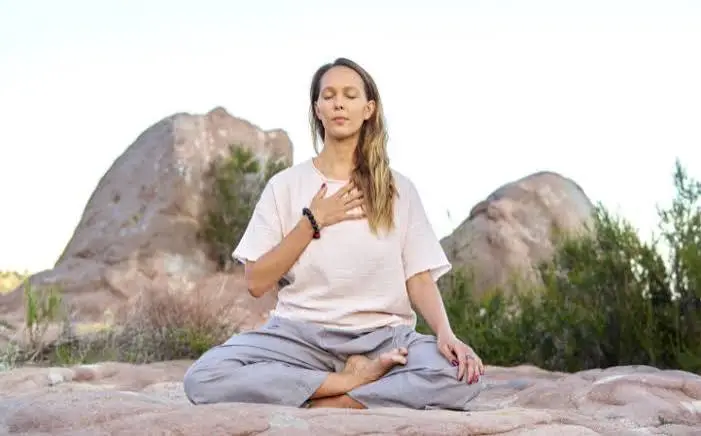
Meditation for beginners can start with five minutes a day. Sit somewhere comfortable, rest your attention on your natural breathing, and each time your mind wanders, notice it and come back. You do not need to empty your mind, hold a perfect posture or feel anything special in your first session.
That can sound too simple. Yet people who mean to begin rarely stall on technique. They stall on conditions: waiting for the right time, the right place, the right method and, sometimes, the right version of themselves. I think five unhurried minutes is a better place to start than waiting for any of those.
What meditation is, and what it is not
The Art of Living describes meditation as “the way to take deep rest and be alert and conscious at the same time”, and as “the delicate art of doing nothing and letting go of all efforts” (Art of Living meditation overview). Both descriptions challenge the familiar picture of meditation as a feat of concentration.
Different traditions teach different methods, including mantra, guided meditation and breath awareness. Watching the breath is one accessible way to get used to sitting quietly and seeing what the mind does.
One clarification before you try it: the exercise below is a general introductory practice, not an Art of Living technique. It is no substitute for learning a specific method from a qualified teacher.
Why five minutes, and not twenty?
Many guides suggest longer sessions. The NHS beginner’s guide calls 20 minutes “a good guide”, and the Art of Living’s meditation guide suggests 20 to 25 minutes per sitting. These are useful reference points, but they need not be the starting point for everyone.
Five minutes is not a better number. It is an easier first step for someone whose mornings are already taken up by work, family, commuting or getting children to school. The Art of Living’s overview makes the point simply: “everyone should meditate for a few minutes every day”.
Five minutes is not guaranteed to produce any particular result. The idea is to start at a length you can keep returning to, then sit for longer when you want to.
A five-minute meditation for beginners
You need no special clothing or equipment, and a chair works as well as a floor cushion. The Art of Living’s meditation guide offers two practical suggestions: do a few gentle stretches first, and avoid sitting on a full stomach. Just before a meal, or a couple of hours after one, may feel more comfortable.
Minute 1: Settle in
Sit so that you feel supported, with your back upright but not stiff and your hands resting wherever they are comfortable. Close your eyes or keep them softly open. Silence your phone and set a gentle timer so you are not checking the clock. The only task in this minute is to stop.
Minute 2: Notice your breathing
Bring your attention to the sensation of breathing: the air at the nostrils, the movement of the chest, or the rise and fall of the abdomen. Leave the breath as it is. Do not take deep breaths, hold it or count a pattern. You are observing it, not controlling it.
Minutes 3 and 4: Notice, and come back
Thoughts will appear: an unfinished task, a conversation, lunch, whether you are doing this correctly. When you realise your attention has drifted, return it to the breath. That noticing and returning is the practice, not a failure of it.
Minute 5: Finish slowly
When the timer sounds, stay where you are for a moment. Notice how you are sitting and the sounds around you, then open your eyes. Resist the urge to grade the session. You made time for it, and that is enough for today.
What if my mind will not stop thinking?
This is one of the most common worries for new meditators. Many assume a good session means a blank mind, and conclude they are failing when the thoughts keep coming.
The NHS puts it plainly: “a wandering mind is a natural part of meditation practice”. It adds: “If your mind wanders off 10 times during a meditation, bring it back to the breath 10 times.” When old memories surface during meditation, Gurudev Sri Sri Ravi Shankar’s answer, quoted on the Art of Living’s overview page, is equally unhurried: “Don’t lose heart! Let them come!”
Some days the mind will feel settled and on others it will be busy. Neither tells you whether you are good at meditation. If sitting with your eyes closed feels uncomfortable, keep them open, try a short guided meditation, or take a slow walk while paying attention to each step.
What can five minutes do for your wellbeing?
Research on meditation is extensive, but findings vary by practice and outcome. The US National Center for Complementary and Integrative Health (NCCIH) reports that some analyses found mindfulness-based approaches helpful for symptoms of anxiety and depression. It also urges caution in interpreting the evidence.
- Some research has been preliminary or has not used rigorous methods.
- Findings vary across the different mindfulness-based approaches and outcomes studied.
- NCCIH notes that the few studies following participants for longer than two months found no long-term effects of the mindfulness-based practices they examined.
Those studies examined structured mindfulness programmes, not five-minute breath-awareness sessions, so their findings cannot simply be applied to the practice above.
A realistic expectation for a beginner is modest: learn the practice, notice how you respond and decide whether to continue. Meditation is not a replacement for medical or mental-health care, and NCCIH advises against using it as a reason to delay seeing a health professional.
Meditation is generally considered low-risk, but it is not risk-free. NCCIH cites a 2020 review of 83 studies involving 6,703 participants; about 8 per cent of participants reported a negative effect, most often anxiety or depression. This is a summary of experiences reported across the studies reviewed, not a prediction of any one person’s risk. If a practice increases your anxiety or brings up distressing feelings, stop or adapt it. Speak to a qualified health professional if the distress continues.
How to make five minutes a daily habit
Attach the practice to something you already do every day rather than relying on willpower. You might sit after brushing your teeth, before opening work messages, or at whatever point suits your household. Keep to the same point for one week.
- Keep the time fixed and the session short. A routine you can maintain beats an ambitious schedule you keep skipping. Sit longer only when you want to.
- Don’t compare. Someone else’s account of deep stillness says nothing about whether your session was worthwhile.
- If you miss a day, start again the next. No catch-up session is needed.
- Look for guidance when you are ready. The Art of Living’s meditation guide covers posture, timing and guided meditations. Our introduction to the Art of Living explains how breath and meditation fit into its wider teaching.
A thought for your first week
In my view, meditation should not become another scale for measuring whether we are productive, disciplined or calm enough. It is easy to bring expectations even to a helpful practice (I should feel peaceful; I should be able to focus; I should notice a difference by Friday), and those expectations become one more distraction.
So give yourself five minutes in which you are not finishing a task or proving anything. Sit, notice the breath and come back when you drift. Tomorrow, you can decide whether to sit again.
[…] is not ordinary breath awareness. Simply noticing your natural breathing, as in our five-minute meditation guide for beginners, is a separate and much simpler exercise. It is a reasonable way to start sitting quietly, but it […]
[…] find that a few quiet minutes of meditation help them pause and notice what is going on. Our five-minute guide to meditation for beginners offers a simple starting point. It is one tool among several, not a treatment, and it is not a […]